The Taskmaster Approach to Creativity: Why Joyful Problem-Solving Matters More Than Ever
by Dr Ali Struthers

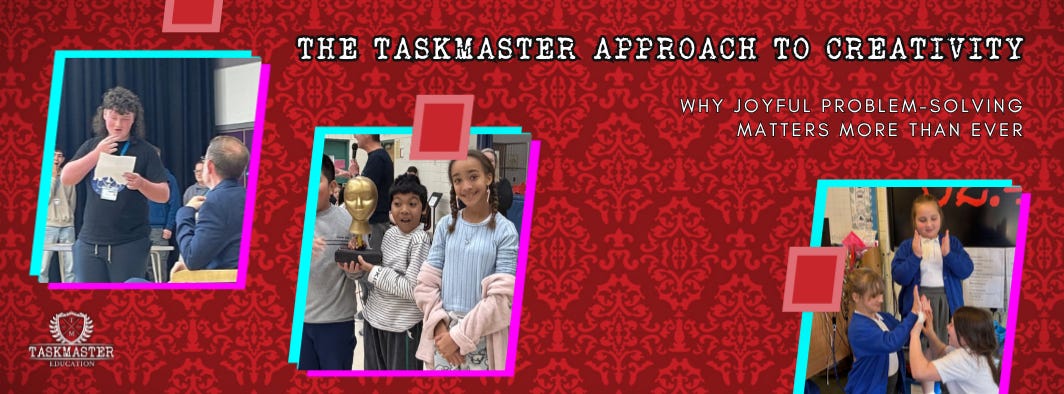
As artificial intelligence becomes increasingly capable of performing routine cognitive tasks, one distinctly human ability is becoming more valuable than ever: creativity.
Not creativity in the narrow sense of artistic talent, but rather the ability to approach problems from unexpected angles and to generate novel, innovative ideas under pressure. These are the skills that will help young people thrive in an AI-enabled world, but they equally tend to often be the very skills our education systems struggle to nurture.
This is why, at Taskmaster Education, we believe the format of the joyful, enigmatic TV show offers such an exciting model for education.
Why the Taskmaster Format Works
One of the joys of Taskmaster is that success rarely depends on being the smartest person in the room. Indeed, we know all too well from Jack Bernhardt’s show stats that Oxbridge graduates are often the lowest-scoring Taskmaster contestants. Contestants succeed instead through imagination, practical thinking, teamwork, communication, persistence, physical dexterity, humour, or simply by seeing a challenge differently from everyone else. Every contestant brings something unique.
The same is true of young people. Not every child excels in mathematics, sport, music, or public speaking. But every child has strengths that can emerge when they’re given the right kind of challenge.
That’s the thinking behind Taskmaster Clubs. Rather than focusing on finding the “correct” answer, participants tackle open-ended challenges that reward originality, collaboration, and innovative thinking. The result is an environment where creativity becomes an advantage rather than a risk.
The Freedom to Think Differently
Traditional assessment methods often encourage convergent thinking: identify the right answer, follow the expected method, avoid mistakes. There are good reasons for this in many contexts, but it can also unintentionally discourage experimentation. Children quickly learn that thinking differently can sometimes mean getting the answer “wrong” and, over time, they may give up following their curiosity and creative impulses. Our education system can end up encouraging children to simply play it safe.
Taskmaster-style challenges can provide an antidote to these pressures. When there isn’t a single correct solution, young participants feel freer to experiment. Less confident children discover that they cannot fail simply because their answer is different. Instead, originality is celebrated and they begin to appreciate that standing out is often the route to success. The challenge is not in discovering creativity in young people. It’s in preserving it.
Why Declining Creativity Matters
Research has long suggested that creative thinking diminishes as children move through formal education. This decline isn’t inevitable. Educational systems that prioritise correct answers, standardised assessment, and consistent methods naturally encourage convergent thinking. Layer onto that the pressures many young people now face – including social media, where public visibility can make failure feel far more consequential – and creative risk-taking becomes increasingly difficult.
These trends matter because the world is changing rapidly. Artificial intelligence is becoming exceptionally good at producing competent, predictable answers. It can summarise information, draft documents, generate code and solve many structured problems. What remains uniquely valuable are the skills that AI still struggles to replicate consistently, including reframing problems, navigating ambiguity, and collaborating with others. These are precisely the capabilities that Taskmaster-style activities develop.
Perhaps the most powerful aspect of the Taskmaster format is its relationship with failure.
Failure isn’t punished. It isn’t embarrassing. It’s entertaining.
That creates something increasingly rare: consequence-free opportunities to take creative risks. For children experiencing perfectionism, performance anxiety, or the constant pressure of comparison, this kind of environment offers permission to experiment without fear.
That permission matters. Because the future won’t simply reward those who know the correct answers. It will reward those who can ask better questions and collaborate to solve problems that don’t yet have established solutions. The Taskmaster approach reminds us that creativity isn’t something reserved for artists or inventors. It’s a way of thinking.
And perhaps the best way to nurture it is by giving young people permission to play, experiment, fail joyfully. And, ultimately, surprise us all.